Corners are where races are won and lost. Whether you’re a beginner learning the basics or an intermediate rider looking to shave seconds off your lap times, mastering corner entry and exit on a dirt track is one of the most impactful skills you can develop. The good news: with the right technique and a little focused practice, smooth, confident cornering is completely within reach.
Why Corners Matter More Than Straights
It might seem like top-end speed on the straights is what separates fast riders from slow ones—but corners tell a different story. A rider who enters and exits corners efficiently carries more momentum through the entire lap. Poor corner technique means scrubbing speed, fighting the bike, and spending extra energy recovering from mistakes. Nail your corners, and the straights take care of themselves.
Setting Up for Corner Entry
Good cornering starts well before you reach the turn. Begin braking in a straight line while the bike is upright—this gives you maximum braking traction and keeps the chassis stable. As you approach, get into your attack position: elbows up, weight centered, and knees gripping the tank. Pick your entry point early so you’re not making last-second adjustments under braking.
For most dirt track corners, you’ll want to enter wide to give yourself the best possible arc through the turn. Think of a smooth, sweeping line rather than a sharp, late stab at the corner. Come in too hot or too tight, and you’ll either run wide on exit or lose the front end entirely.
Body Position Through the Turn
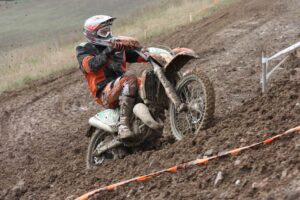
Once you’re committed to the corner, body position becomes critical. Shift your weight toward the outside peg to help the bike track through the turn, and keep your inside elbow up—this opens your chest and keeps the front wheel loaded correctly. Look through the corner toward your exit point, not down at the dirt in front of your wheel. Your bike will follow your eyes.
Stay relaxed. Tension in your arms is one of the most common mistakes riders make in corners. Stiff arms transfer every bump and twitch from the bars directly into your steering, making the bike unpredictable. Let the bike work beneath you and guide it rather than force it.
Hitting the Apex and Powering Out
The apex is the innermost point of your cornering line—the moment where you transition from turning to accelerating. Aim to clip it smoothly, not abruptly. Hitting the apex too early pushes you wide on exit; too late and you sacrifice drive coming out of the turn.
As you reach the apex, begin rolling on the throttle progressively. Smooth, gradual throttle application keeps the rear tire hooked up and drives you forward. A hard, sudden burst of power will break the rear loose before you’re ready—fun to look at, not great for lap times. Let the power build as you straighten the bars and accelerate out of the corner.
Practice Drills to Build Consistency
The fastest way to improve your cornering is repetition with intention. Pick a single corner and ride it 10–15 times in a row, focusing on one element at a time—entry speed, body position, apex, then exit throttle. Slow-speed figure-eight drills in an open area are also excellent for developing feel and balance through turns. Video yourself if you can; what feels smooth often looks very different on camera.
Ready to take your cornering—and your entire riding game—to the next level? At 2020 Racing Academy, our coaches work with riders of all skill levels to build real, lasting technique in a safe, structured environment. View our programs and find out how we can help you ride faster, smoother, and with more confidence.