There’s a moment every off-road rider knows—you’re rolling into a tight, technical section of single-track, the trail narrows, roots and rocks appear out of nowhere, and suddenly your brain has to process a dozen decisions in about two seconds. Where do you point the front wheel? Do you go high or low? Take the smooth arc or the shortest path?
Line selection is one of the most important—and most underestimated—skills in off-road riding. Beginners tend to focus on braking and throttle, but experienced riders know that where you ride is just as critical as how you ride. Here’s how to start thinking like a trail-reading machine.
What Is Line Selection, and Why Does It Matter?
Your “line” is the specific path you choose through any given section of trail. On single-track, options are often limited—but there’s almost always more than one way through. A smart line means fewer obstacles, better traction, smoother transitions, and more speed with less effort.
Poor line selection leads to awkward weight shifts, panic braking, and the kind of survival riding that leaves you exhausted halfway through a ride. Learning to read the trail is a skill that compounds—every ride you get a little sharper, a little faster, and a lot more in control.
Look Ahead, Not Down
The single biggest habit change that improves line selection is where you focus your eyes. Most newer riders stare at the ground directly in front of their wheel—which means they’re constantly reacting instead of planning. The goal is to push your vision forward, at least five to ten feet beyond your front wheel.
This gives your brain the time it needs to evaluate options and commit to a line before you’re already deep in trouble. On faster single-track, look even further. Think of it like driving on a winding road: you don’t stare at the hood—you look through the corner.
High Line vs. Low Line: Know the Difference
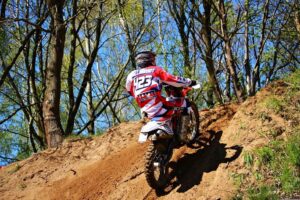
On bermed corners or hillside terrain, you’ll typically have a choice between a high line (the outside edge of the trail) and a low line (tighter, inside edge). Each has its place.
High lines often offer better traction and a more gradual arc—great when the inside is rutted or slippery. Low lines can be faster when the inside is packed and grippy, but they tighten the corner radius and demand precise speed management. As a general rule, choose the line that keeps your momentum flowing and avoids abrupt corrections. A smooth, slightly longer line almost always beats a short one that forces a hard brake.
Roots, Rocks, and Ruts: Navigating Obstacles Smartly
Technical single-track is full of natural obstacles, and how you approach them defines your skill level. For roots and rocks, aim to cross them at a perpendicular angle whenever possible—this distributes impact evenly and reduces the chance of the front wheel deflecting sideways.
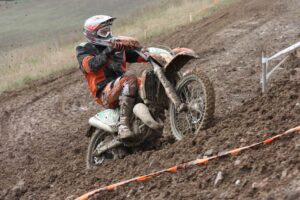
With ruts, the golden rule is to commit. A half-hearted entry into a rut often ends worse than riding it out cleanly. If a rut runs in your direction of travel, settle in and let the bike track. When you need to exit, look for a point where the edge is low and gradual, then power out smoothly with controlled throttle.
Build the Habit: Drills and Repetition
Line selection improves most quickly through deliberate practice. One effective drill: ride a familiar trail section multiple times, deliberately choosing a different line each pass. Notice how each choice affects your speed, balance, and energy output. Over time, reading terrain becomes instinctive—your eyes and brain build a library of patterns and solutions you can draw on automatically.
Riding with more experienced riders is equally valuable. Watch where they go, not just how fast they go. You’ll quickly pick up on the patterns behind their line choices and start to understand the “why” that makes the difference between riding a trail and flowing through it.
Ready to sharpen your trail skills with expert coaching? At 2020 Racing Academy, our programs are built around real-world off-road technique in a structured, confidence-building environment. Whether you’re just getting started or looking to break through a plateau, we have the coaching to get you there. View our programs and take the next step toward becoming a smarter, faster, more capable rider.