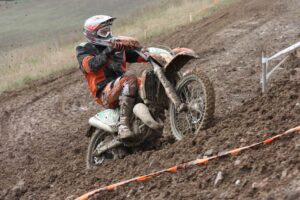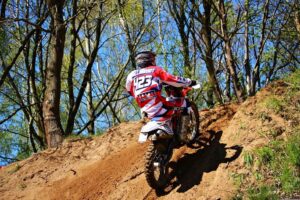
Rain doesn’t have to mean a rest day. Some of the most rewarding off-road riding happens when the trail is soaked, the mud is flying, and the challenge is real. But wet and muddy conditions demand a different approach—one that rewards patience, smooth inputs, and smart technique over brute force. Here’s what you need to know to tackle slippery terrain with confidence.
Why Wet Conditions Change Everything
When moisture hits the trail, traction drops dramatically. Roots, rocks, and hardpack become unpredictable. Mud can grab your front wheel, push you wide, or suck your tires deep into ruts. The instinct is to tense up and fight the bike—but that’s exactly the wrong move. Wet riding rewards riders who stay loose, read the terrain early, and commit to smooth, deliberate inputs. The moment you start wrestling the bars, you’ve already lost the battle.
Body Position: Stay Active and Stay Loose
In slippery conditions, your body position matters even more than usual. Stand on the pegs with slightly bent knees and elbows up and out—this gives you a natural suspension system that absorbs the unexpected. Keep your weight centered or slightly rearward to help your front wheel maintain contact without washing out. Avoid death-gripping the bars. Let the bike move beneath you. Rigid riders fall; loose riders flow.
Throttle and Braking: Smooth Is the Only Rule
Abrupt throttle inputs on slick terrain will spin the rear wheel and send you sideways in an instant. Think of your throttle as a dimmer switch, not a light toggle—roll it on gradually and maintain steady momentum through technical sections. The same principle applies to braking. Grabbing a fistful of front brake on wet rock or mud is a guaranteed way to go down. Instead, use light, progressive pressure on both brakes, and weight your outside peg through corners to help stabilize the chassis.
Line Selection in the Mud
Your usual lines may be completely useless when it’s wet. Deep ruts can actually work in your favor—they act as rails and keep you tracking straight—but they can also trap you if you need to bail. Look further ahead than normal and plan your exits before you commit. On hills, try to ride the grass or hardpack edges rather than the center groove, which often becomes a river of mud. In corners, take a wider entry to reduce lean angle and minimize the chance of the front end washing out.
Bike Setup and Post-Ride Care for Wet Days
A few small adjustments can make a big difference before you drop the gate. Lower your tire pressure slightly—even a few PSI—to increase the contact patch and improve grip on loose, wet surfaces. If your suspension is set up firm for hardpack, soften the compression a touch to keep both wheels tracking over slippery ground. After your ride, clean your air filter thoroughly—mud and moisture are among the fastest ways to shorten an engine’s life. A quick rinse of the drivetrain and brake rotors will also pay dividends the next time out.
Riding confidently in wet and muddy conditions is a skill that takes practice, and the best way to build it is under structured guidance. At 2020 Racing Academy, our coaches work with riders of all experience levels to develop the technique, body awareness, and mental composure that translate directly to real-world trail performance—rain or shine. Ready to ride better no matter what the weather throws at you? View our programs and take the next step in your off-road journey.
Image by jrm – photo from Pixabay